September 10, 2026
In this article
- What You Will Learn From This Blog
- Why Bank Reconciliation Matters
- How to Reconcile a Bank Statement Manually
- Common Bank Reconciliation Mistakes to Avoid
- How Often Should You Reconcile Bank Statements?
- Manual Bank Reconciliation Takes Time
- A Faster Way to Reconcile Bank Statements: Automated Bank Feeds
- How CashBooks Makes Bank Reconciliation Faster
- How Much Time Can Automated Bank Feeds Save?
- Bank Reconciliation Checklist
- Key Takeaways
- FAQs
Learning how to reconcile a bank statement starts with a simple question: does your bank balance match your books? If it does not, there may be a payment that has not cleared, a missing bank fee, a duplicate entry, or a transaction that was never recorded. A bank reconciliation helps you find these gaps before they turn into bigger bookkeeping problems.
The process is straightforward, but checking every deposit, payment, fee, and adjustment by hand can take time. In this blog, we’ll walk through the reconciliation process step by step, cover common mistakes, and explain how often you should reconcile your accounts.
Then, we’ll look at a faster approach. Automated bank feeds can bring transactions into your accounting system, reduce manual matching, and help you spend less time checking every line item.
What You Will Learn From This Blog
By the end of this blog, you will know:
- What bank reconciliation is and why it matters
- How to reconcile a bank statement manually
- How to find and fix gaps in your records
- Which bank reconciliation errors are most common
- How often you should check your bank records
- How smart bank feeds can make the task much faster
Why Bank Reconciliation Matters
Bank reconciliation is a basic part of good bookkeeping. It gives you a way to check that your books match what took place in your bank.
A bank reconciliation can help you:
- Catch data entry errors
- Find missed bank feeds
- Spot duplicate entries
- Find odd or false charges
- Find cash that was not yet logged
- Keep your books ready for review or audit
It also gives you a clearer view of your cash. When your books are up to date, you can make better calls about bills, sales, and cash flow.
How to Reconcile a Bank Statement Manually
You do not need a tool to learn how to reconcile a bank statement. You can do it with a bank statement, your books, and a clear set of steps.
Step 1: Get Your Bank Statement and Books
Start with the bank statement for the period you want to check. This may be a month, week, or other set time.
You also need your cash ledger or accounting records for that same time. If you use a sheet, open the file. If you use accounting software, open the bank or cash account.
Check that both records cover the same start and end dates.
Step 2: Check the Opening Balance
Look at the start balance on your bank statement. Then check the start balance in your books.
These two amounts should match.
If they do not, do not move on yet. A gap in the starting balance can point to an old error or a past reconciliation that was not done right.
Step 3: Match Deposits
Next, check each deposit on the bank statement against the deposits in your books.
Look at the:
- Date
- Amount
- Name or source
- Bank note or ref, if shown
Put a mark next to each item once you find the same item in your books.
A deposit may be in your books but not yet on the bank statement. This can happen when a check or other cash item is still in the bank's hold time.
Step 4: Match Payments and Withdrawals
Now do the same for cash that left the bank.
Check items such as:
- Checks
- Card charges
- ACH payments
- Bank fees
- Loan payments
- Wire fees
- Other bank charges
Match each bank item to an entry in your books. Check both the date and amount. A small date gap can be fine, but the amount should make sense.
Step 5: Look for Missing or Outstanding Items
Once you have matched the main items, look at what is left.
You may find a charge on the bank statement that is not in your books. You may also find an item in your books that has not yet hit the bank.
Common causes include:
- Checks not yet cashed
- Deposits still in transit
- Bank fees not yet logged
- Interest income not yet logged
- Card charges posted at a later date
- A payment that was left out of the books
Make a list of these items. Do not remove a valid item just because it has not cleared yet.
Step 6: Find and Fix Differences
If the two balances still do not match, work through the gap.
Start with the most likely causes. Check for a wrong amount, a missing entry, a duplicate entry, or a transaction in the wrong account.
For example, a $520 payment entered as $250 creates a $270 gap. A payment entered twice can also create a gap.
Fix the source record rather than making a fake entry just to make the totals match.
Step 7: Check the Ending Balance
After all needed fixes, compare the final balance in your books with the bank balance, while also allowing for valid items that have not cleared.
The key is to explain every gap.
Reconciliation does not mean that every item has to clear on the same day. It means that each difference has a valid reason.
Step 8: Save the Reconciliation
Keep a copy of the bank statement and your final reconciliation. Add notes for any open items that need more work.
This gives you a clear record of what was checked and when. It can also help your bookkeeper or accountant review your work later.
Common Bank Reconciliation Mistakes to Avoid
Even a simple bank reconciliation can go wrong. These are some of the most common issues.
Missing Bank Fees
Banks may add monthly fees, wire fees, or other charges. If these are not in your books, the balances will not match.
How to avoid it: Review all bank charges, not just sales and bill payments.
Adding a Transaction Twice
A payment may get logged manually and then added again from a bank feed. This can make your cash balance too low.
How to avoid it: Check the date, amount, and payee before you add an entry.
Missing Outstanding Items
A check may be in your books but still not show on the bank statement. A deposit may also be in transit.
How to avoid it: Keep a list of items that have not cleared yet.
Using the Wrong Date
The date in your books may not be the date the bank posts the item. This can make a valid item look like a missing one.
How to avoid it: Check both the transaction date and the bank post date when needed.
Ignoring Small Gaps
A small gap can still point to a real issue. Small errors can add up over time.
How to avoid it: Find the cause of each gap before you close the reconciliation.
Not Reviewing Odd Transactions
A bank reconciliation is more than a math check. It can also help you spot charges that you do not know.
How to avoid it: Review unusual payments, new payees, and charges that do not fit your normal spend.
How Often Should You Reconcile Bank Statements?
There is no one rule for how often you should reconcile bank statements. The right pace depends on how much money moves through the account and how much risk a delay may cause.
Monthly Reconciliation
Monthly checks work well for many small firms with a low number of bank entries. A monthly reconciliation gives you a set point to review your books and bank balance.
Weekly Reconciliation
Weekly checks make more sense when you have many sales, bills, card charges, or bank moves. More checks mean less work to sort out at the end of the month.
Weekly checks can also help firms that need a close view of cash.
More Often for High Volume Accounts
Some firms may need to check cash more often than once a week. If a bank account has a high flow of cash, a small error can grow fast.
The main rule is simple: the more bank activity you have, the more often you should reconcile bank statements.
Manual Bank Reconciliation Takes Time
The steps above work. But they can take a lot of time when done by hand.
A typical manual process include:
- Downloading or importing bank data
- Comparing each entry one by one
- Finding matching deposits and payments
- Sorting each transaction into the right account
- Looking for missing entries
- Checking for duplicate entries
- Finding the cause of each gap
- Updating your books
For a small set of bank entries, this may not be a big task. But when you have many entries each week, the same steps can take hours.
That raises a fair question:
What if your accounting software could do much of this work for you?
A Faster Way to Reconcile Bank Statements: Automated Bank Feeds
Automated bank feeds can remove much of the manual work from a bank reconciliation.
Instead of getting a bank statement and typing each item into your books, your bank can send transaction data to your accounting system. The system can then sort, match, and flag items for review.
This does not mean you should skip the review. You still need to check the work. But you spend less time doing basic data entry and more time on items that need your eye.
AI can take this a step further. It can learn from past choices and suggest the right account for new transactions. It can also help find likely matches between bank items and entries in your books.
How CashBooks Makes Bank Reconciliation Faster
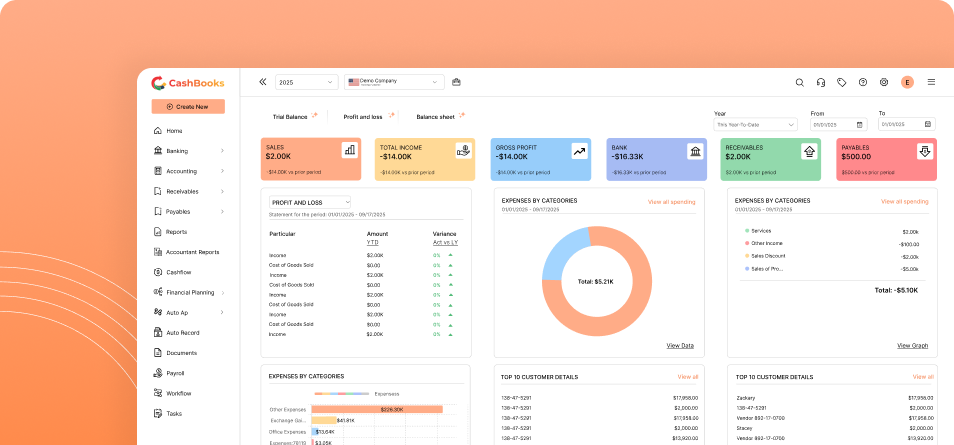
CashBooks is built to make accounting faster with AI across the workflow.
Our smart bank feeds bring bank transactions into your books, so you do not have to enter each item manually. AI can help sort transactions based on your chart of accounts and past choices.
CashBooks can also help with:
- AI transaction categorization: Get suggested categories for bank activity.
- Smart bank feeds: Bring bank activity into your books with less manual work.
- Suggested reconciliation matches: Review likely matches instead of finding each one by hand.
- Duplicate and missing entry checks: Help spot records that may need a closer look.
- Unusual transaction alerts: Bring odd items to your attention.
- Accounting firm reports: Give firms clean reports for review and client work.
The result is a shift from doing every step by hand to reviewing the work that needs your input.
| Manual reconciliation | With CashBooks |
|---|---|
| Download bank statement | Bank feed imports transactions |
| Review transactions one by one | Transactions are organized for review |
| Categorize each transaction | AI suggests categories |
| Match transactions by hand | Suggested matches speed up the task |
| Search for duplicate entries | Duplicate entries can be flagged |
| Look for missing items | Missing or odd entries can be surfaced |
How Much Time Can Automated Bank Feeds Save?
The time saved depends on your bank, account setup, and the number of transactions you have.
The basic change looks like this:
Manual: Download → compare → categorize → match → investigate → reconcile
Automated: Connect → review suggestions → fix exceptions → reconcile
For a low-volume account, the time gain may be small. For an account with many entries, removing repeated data entry and match work can make a much bigger difference.
The goal is not to remove human review. It is to reduce the work that does not need to be done manually.
Bank Reconciliation Checklist
Use this list each time you reconcile your account:
- ☐ Gather your bank and accounting records
- ☐ Check the opening balance
- ☐ Match deposits
- ☐ Match payments and withdrawals
- ☐ Check bank fees and interest
- ☐ Find outstanding transactions
- ☐ Investigate all gaps
- ☐ Check for duplicate and missing entries
- ☐ Confirm the ending balance
- ☐ Save the final reconciliation records
Key Takeaways
- Reconcile bank statements regularly to keep your books accurate.
- Investigate every unexplained difference instead of forcing a match.
- Separate timing differences from actual accounting errors.
- Review unusual, duplicate, and missing transactions.
- Keep reconciliation records for future review and audits.
- Use automated bank feeds to reduce manual data entry and matching.
- Use AI to speed up transaction categorization and reconciliation.
FAQs
What happens if a bank reconciliation is not completed?
Unreconciled accounts can hide missing entries, errors, or unusual activity, making your cash balance less reliable.
Can a bank reconciliation have a difference and still be correct?
Yes. Timing items such as outstanding checks or deposits in transit can create valid differences that should be documented and cleared later.
What is the most common bank reconciliation error?
Missing transactions are a common cause, especially bank fees, interest, automatic payments, and deposits that were not recorded in the books.
Who should review a bank reconciliation?
The person handling the books can prepare it, but important accounts should ideally have an independent review to catch errors or unusual activity.
What records should you keep after reconciling a bank account?
Keep the bank statement, reconciliation report, and notes or support for any outstanding or adjusted items.