
July 30, 2026
In this article
- What You Will Learn From This Blog
- Introduction To Bookkeeping Automation Software
- Why Manual Accounting Processes Slow Business Growth
- How Bookkeeping Automation Software Uses AI To Automate Financial Tasks
- Key Features of AI Bookkeeping Software
- How AI Detects Errors, Duplicate Entries, and Missing Transactions Before They Become Problems
- What to Look For in Bookkeeping Automation Software Before You Invest
- Why Businesses Choose CashBooks.io
- Our Expert Perspective
- Key Takeaways
- FAQs
Managing accounting tasks manually requires significant time and effort. Recording invoices, expenses, payments, and bank transactions by hand increases workload and raises the risk of errors as business transactions grow. Bookkeeping automation software uses artificial intelligence to automate routine accounting tasks such as transaction categorization, bank reconciliation, invoice processing, and financial data review.
Modern automated bookkeeping software reduces manual work, keeps financial records organized, and allows accountants to focus more on financial analysis and business decisions. As a result, businesses can manage their finances more efficiently while maintaining accurate and up-to-date accounting records.
What You Will Learn From This Blog
- Understand what bookkeeping automation software is and how it works.
- Learn why manual accounting creates delays and increases workload.
- Explore how AI automates daily bookkeeping activities.
- Explore important features available in modern AI bookkeeping software.
- Know how AI detects accounting mistakes before they affect reports.
- Find out what to consider before investing in accounting automation software.
Introduction To Bookkeeping Automation Software
Bookkeeping automation software simplifies financial management by automating routine accounting tasks that traditionally require manual effort. It records transactions directly from connected bank accounts, payment gateways, and business applications while reducing the need for manual data entry.
Using AI bookkeeping software, the system also categorizes income, expenses, and payments based on transaction history and accounting rules. The software keeps financial records updated in real time, allowing businesses to review current financial information without waiting for month-end. It also automates repetitive tasks such as bank reconciliation, invoice processing, expense categorization, and receipt matching, allowing accountants to spend more time on financial review and business planning.
Another important advantage is its ability to maintain consistent financial accuracy by applying accounting rules across every transaction. Most bookkeeping automation software also integrates with banking platforms, invoicing tools, inventory systems, payment processors, and accounting applications, creating a connected workflow that keeps financial data organized and easy to manage.
Why Manual Accounting Processes Slow Business Growth
Time-Consuming Data Entry
Manual bookkeeping requires accountants to enter every invoice, payment, expense, and journal entry separately. As transaction volume increases, the workload grows significantly and consumes valuable working hours.
Higher Risk Of Human Errors
Typing mistakes, incorrect account selection, duplicate entries, and missed transactions may occur during manual bookkeeping. Small errors can affect financial statements, tax preparation, and management reports.
Delayed Financial Reporting
Business owners depend on timely financial reports to make informed decisions. Manual accounting often delays month-end closing because accountants must verify, reconcile, and review every transaction individually.
Limited Business Visibility
When accounting records are updated only after manual processing, managers cannot view current financial performance. Delayed information may slow business planning and cash flow management.
Increased Operational Costs
Growing businesses usually require additional accounting staff to manage increasing transaction volumes. Bookkeeping automation software reduces repetitive tasks, allowing existing teams to handle larger workloads efficiently.
Reduced Focus On Financial Analysis
Accountants spend many hours entering data instead of reviewing financial trends, identifying cost-saving opportunities, or providing business recommendations. Automation shifts attention toward higher-value financial activities.
How Bookkeeping Automation Software Uses AI To Automate Financial Tasks
Intelligent Transaction Categorization
Bookkeeping automation software analyzes payment details, transaction history, vendor information, and accounting rules to assign transactions to the correct accounts. AI bookkeeping software also learns recurring patterns over time, making future categorization faster and more consistent.
Automated Bank Reconciliation
The software automatically matches bank transactions with accounting records and highlights only unmatched entries for review. This reduces reconciliation time while maintaining accurate and up-to-date financial records.
Invoice Processing
Modern automated bookkeeping software captures invoice details, verifies information, and records transactions automatically. This reduces manual document handling and speeds up invoice processing.
Expense Management
Expense management becomes easier by capturing receipt data, categorizing costs, and applying company policies automatically. This creates a faster approval process while keeping expense records organized.
Cash Flow Monitoring
The software continuously tracks incoming and outgoing payments, providing businesses with current cash flow information. Managers can quickly identify delayed payments or rising expenses before they affect business operations.
Continuous Financial Review
Unlike manual bookkeeping, modern automated bookkeeping software reviews transactions throughout the accounting period instead of only at month-end. It detects unusual activities, missing transactions, and account inconsistencies before financial reports are prepared.
Key Features of AI Bookkeeping Software
Automatic Transaction Matching
Modern bookkeeping automation software matches bank transactions with invoices, bills, and payments without requiring accountants to compare records manually. This shortens reconciliation time and keeps books current throughout the month.
Smart Receipt Capture
Employees can upload receipts using a mobile device or desktop application. AI bookkeeping software reads the receipt, captures key details, and records the expense in the correct account while keeping digital copies for future reference.
Recurring Transaction Automation
Many businesses process the same rent payments, utility bills, subscriptions, and supplier invoices every month. Bookkeeping automation software automatically records these recurring transactions based on predefined rules, reducing repetitive work.
Automated Invoice Management
The software creates invoices, tracks payment status, sends payment reminders, and records customer receipts automatically. This reduces follow-up work and keeps accounts receivable records organized.
Financial Report Generation
Instead of preparing reports manually, the platform generates financial reports using updated accounting data. It creates Profit and Loss Statements, Balance Sheets, Cash Flow Statements, and other essential reports.
Business owners receive timely financial information that reflects current business performance, making it easier to monitor finances and make informed decisions.
Multi-Business Management
Businesses with multiple branches or entities can manage financial records from one platform. AI bookkeeping software consolidates financial data, making reporting and account monitoring much easier for growing organizations.
Bank Feed Synchronization
The software connects with bank accounts and credit cards to import transactions automatically. This reduces manual data entry and keeps financial records updated regularly.
AI-Powered Expense Categorization
The software analyzes transaction details and assigns expenses to the correct categories. This improves accuracy and reduces the time spent on manual expense reviews.
Real-Time Financial Dashboard
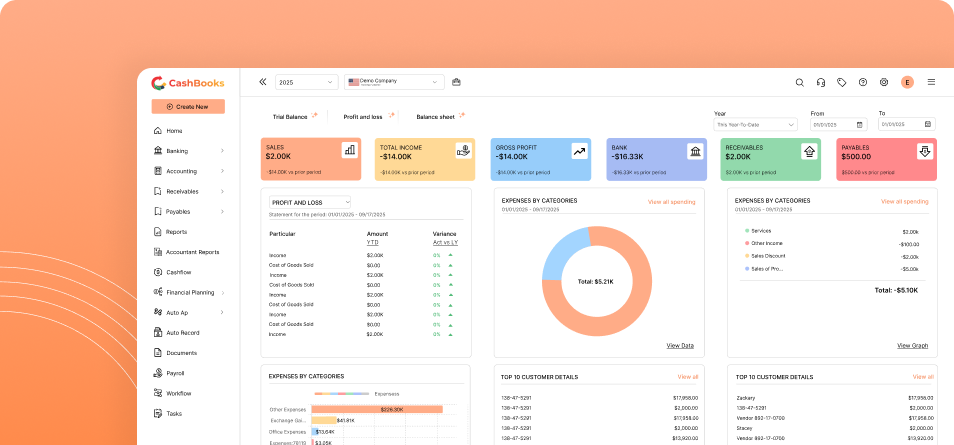
A centralized dashboard displays important financial information, including income, expenses, and account balances. Businesses can quickly review performance without preparing reports manually.
How AI Detects Errors, Duplicate Entries, and Missing Transactions Before They Become Problems
Duplicate Transaction Detection
Duplicate entries often occur when invoices or payments are recorded more than once. Bookkeeping automation software compares transaction amounts, dates, vendor names, and reference numbers to identify duplicate records before reports are finalized.
Missing Transaction Alerts
Bank transactions that have not been recorded in the accounting system can create inaccurate financial statements. AI bookkeeping software compares imported bank data with accounting records and alerts users when transactions are missing.
Unusual Transaction Monitoring
Artificial intelligence reviews historical transaction patterns and identifies entries that differ from normal business activity. These alerts allow accountants to review unexpected payments, unusual expenses, or incorrect postings before month-end reporting.
Balance Verification
Every accounting record should maintain balanced debit and credit entries. The accounting system continuously reviews account balances and identifies inconsistencies that require attention before financial reports are prepared.
Account Coding Validation
Incorrect account selection can affect financial reporting. Automated bookkeeping software checks account coding against previous records and accounting rules, reducing classification errors across the general ledger.
Continuous Data Review
Instead of checking records only during month-end closing, bookkeeping automation software reviews financial information throughout the accounting period. Early detection allows accounting teams to resolve issues before they grow into larger reporting problems.
What to Look For in Bookkeeping Automation Software Before You Invest
AI-Based Automation
Choose software that applies artificial intelligence to transaction categorization, reconciliation, invoice processing, and financial monitoring. Advanced automation reduces manual accounting work while maintaining consistent financial records.
Easy Integration
The software should connect with bank accounts, payment gateways, inventory systems, CRM platforms, and existing accounting applications. Strong integration reduces duplicate work and keeps financial information synchronized.
Strong Security Standards
Financial information contains sensitive business data. Select bookkeeping automation software that offers data encryption, user access controls, secure cloud storage, audit trails, and regular system updates.
Flexible Reporting
Business owners require different financial reports for different decisions. Choose software that generates customizable financial reports, dashboards, and performance summaries with current accounting data.
Scalability
As businesses grow, transaction volume also increases. The right AI bookkeeping software should manage additional customers, suppliers, employees, and business entities without affecting system performance.
Reliable Customer Support
Good technical support becomes valuable during software implementation and daily operations. Select a provider that offers product training, onboarding guidance, documentation, and responsive customer assistance.
Why Businesses Choose CashBooks.io
Managing finances becomes easier when automation works alongside experienced accounting practices. CashBooks.io is an advanced bookkeeping automation software designed for businesses that want to reduce manual accounting work while maintaining accurate financial records.
AI-Powered Bookkeeping
CashBooks.io uses AI bookkeeping software capabilities to automate transaction categorization, reconciliation, and financial organization, reducing repetitive bookkeeping tasks.
Faster Month-End Closing
Automated reconciliation, organized financial records, and real-time reporting allow businesses to complete month-end closing more efficiently while reducing manual reviews.
Smart Financial Reports
Business owners receive current financial reports that provide better visibility into revenue, expenses, profitability, and cash flow without spending hours preparing spreadsheets.
Built For Growing Businesses
Whether you manage one company or multiple business entities, CashBooks.io scales with your accounting requirements while maintaining consistent financial records.
User-Friendly Experience
A simple interface makes it easy for accountants, finance teams, and business owners to manage daily bookkeeping without a lengthy learning process.
Designed For Better Financial Control
CashBooks.io combines automation with practical accounting features, giving businesses greater visibility into financial activity while reducing routine manual work.
Our Expert Perspective
Our experience working with businesses across different industries shows that accounting teams spend a significant part of their day on repetitive activities such as entering transactions, matching bank records, reviewing invoices, and correcting avoidable errors. These tasks are necessary, but they do not always add value to business growth.
Using bookkeeping automation software allows finance teams to spend less time on routine processing and more time reviewing financial performance, planning budgets, managing cash flow, and advising business leaders. Automation should not replace accounting professionals. Instead, it gives them better tools to perform their work with greater consistency and confidence.
Key Takeaways
- Bookkeeping automation software reduces manual data entry and repetitive accounting tasks.
- AI categorizes transactions using previous records and accounting rules.
- Automated reconciliation shortens month-end closing time.
- AI identifies duplicate entries, missing transactions, and unusual financial activity.
- Businesses receive faster financial reports with updated information.
- Cloud-based automation provides better visibility into financial performance.
- Choose software with strong security, integrations, reporting, and scalability.
- Combining experienced accountants with automation delivers more reliable financial management.
FAQs
What Is Bookkeeping Automation Software?
Bookkeeping automation software records financial transactions, categorizes expenses, reconciles bank accounts, and creates reports automatically, reducing the need for manual bookkeeping.
How Does AI Bookkeeping Software Reduce Manual Accounting Work?
AI bookkeeping software uses artificial intelligence to classify transactions, process invoices, detect errors, reconcile bank accounts, and review financial records with minimal manual effort.
Can Small Businesses Use Bookkeeping Automation Software?
Yes. Small businesses can use AI-powered accounting software to save time, reduce bookkeeping errors, organize financial records, and monitor cash flow without increasing their accounting workload.
Is AI Bookkeeping Software Safe For Financial Data?
Most professional AI bookkeeping software uses encryption, secure cloud storage, user permissions, and audit logs to protect financial information. Businesses should also review the provider's security standards before making a decision.
What Features Should I Compare Before Buying Bookkeeping Automation Software?
Compare automation capabilities, bank integration, reporting tools, security features, cloud access, scalability, customer support, and ease of use before selecting bookkeeping automation software for your business.